Communist Hungary and its Arab informers
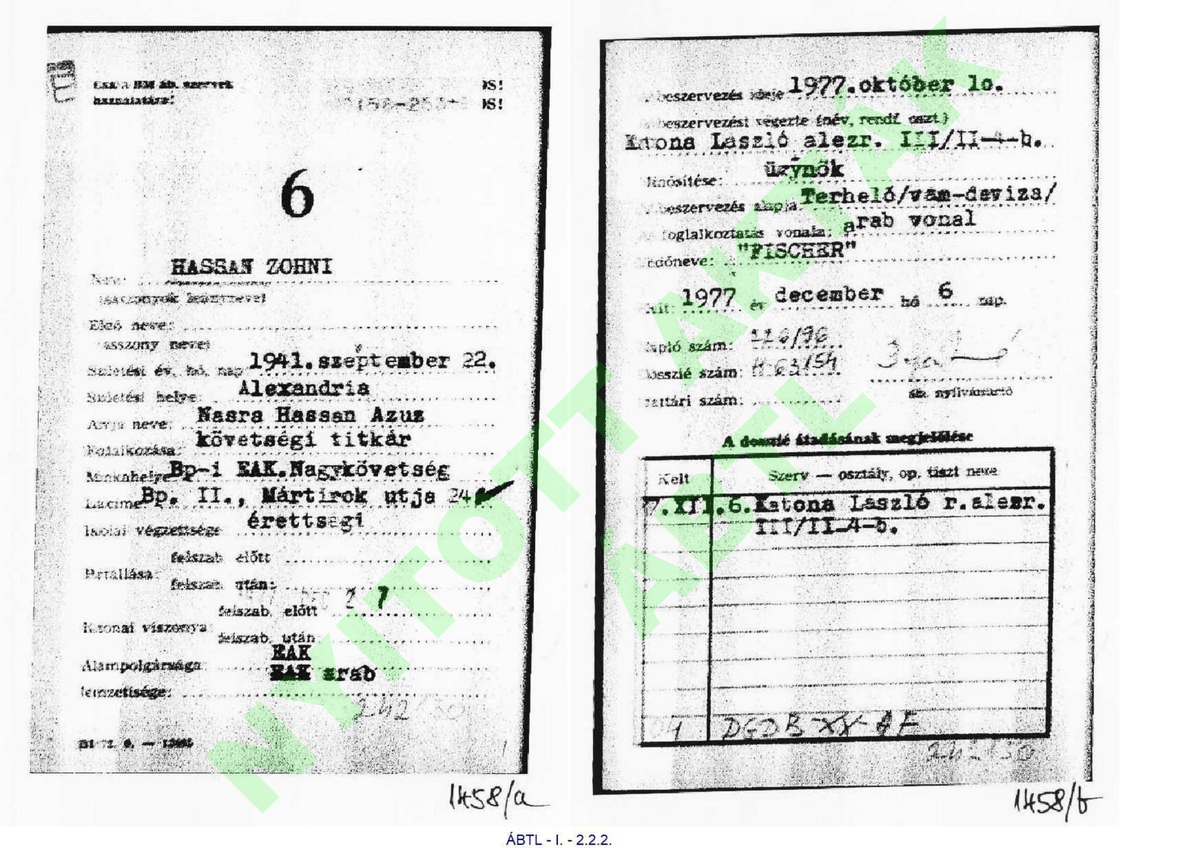
On 10th October 1977, a lieutenant-colonel in Hungarian counter-intelligence recruited a secretary at the Egyptian embassy in Budapest using incriminating evidence of customs and foreign currency offences. He was born in Alexandria in 1941, was given the codename "Fischer" and assigned to watch Arab diplomats, students and other contacts in Hungary.
A year later, the same counter-intelligence branch signed up an interpreter at the Syrian Embassy. This time, the interpreter was recruited "on principle", to report on foreign missions based in Hungary.
Syria was politically close to Hungary's government, being one of the Soviet bloc's closest partners in the Arab world, and a recipient of Warsaw Pact arms, advisers, and scholarships. Egypt had been a close Soviet partner until 1972, when Sadat expelled Soviet advisers and began turning towards the West. Hungary still ran informers inside both countries' embassies.
On 4th November 2026, the Historical Archives of the Hungarian State Security (ÁBTL) put the registry of the communist political police online at Nyitott Akták ("Open Files"). For the first time, anyone can search the people who made up the country's secret police informant network between 1945 and 1990.
I was taking a look at the archives released and found it interesting how a number of Arabs and people from the Middle East were recruited to serve the interests of the Hungarian secret police. Not a lot of information is available right now. The dossiers themselves, the files that say what the sources reported, are due online by 25th February 2027, with other people's personal information redacted.
Throughout the Cold War, Hungary hosted thousands of young people from the Arab world and the Global South on scholarships. The earliest record I found, from February 1969, shows a Syrian scholarship student at the Faculty of Humanities of Eötvös Loránd University (ELTE), born in Aleppo in 1944, who was recruited for counter-espionage under the codename "Ádám". His record was passed between departments, including the Budapest police, until at least 1986. In October 1970, the Csongrád county office signed up a Syrian medical student in Szeged, born in Damascus in 1942, for "youth protection", codename "Jancsó".
In November 1983, four years into the Soviet war in his country, an Afghan medical student at SOTE in Budapest became "Völgyi". On 2nd March 1988 it was the turn of a student at the International Preparatory Institute, where foreigners learned Hungarian before university. He was born in Gaza in 1965 and listed as an Egyptian citizen, and his codename was "Erik". Finally, on 15th May 1989, as the regime was negotiating its own end, a Libyan student at the Budapest Technical University was recruited under the codename "Vera".
The last three records carry the same name in the recruiting-officer field: a lieutenant in department III/III-2-b, the section that watched students. He signed up the Afghan in 1983, the Gazan in 1988 and the Libyan in 1989, by which time he had been promoted to senior lieutenant. One officer spent at least six years cultivating informers among foreign students, and was still doing it weeks after Hungary began dismantling its border fence.
Every record has a field for the basis of recruitment, and while the Hungarians on the cards I saw were both recruited on kompromittáló (compromising) material, the Arab and Afghan informants are almost all recorded as recruited on principle. There is one exception however, the secretary at the Egyptian embassy from the opening paragraph, which is the only record I found to contain the leverage used against him.
How the records describe the basis of recruitment also seems to change with the year the person was recruited. The Syrian student at ELTE in 1969 and a Palestinian worker and the Syrian embassy interpreter in 1978 are all recorded as recruited elvi, on principle. The Syrian student in Szeged in 1970 and a Jordanian translator in 1977 are recorded as hazafias, patriotic. By the 1980s a new phrase appears, where an Afghan student in 1983 is "patriotic/internationalist", and the Gaza-born and Libyan students of 1988 and 1989 are both elvi-internacionalista, principled internationalists. The students were mostly put to work reporting on their fellow students, while the embassy staff and older recruits helped with counter-intelligence.
There were also other Arab people who ended up as part of the network and were neither students nor diplomats, including someone, born in Amman in 1947, whom counter-intelligence recruited in 1977 while he was working as an interpreter-translator for TESCO, Hungary's state company for technical and scientific cooperation abroad. In 1978 the same department recruited a Palestinian, born in Gaza in 1947, who was working as a semi-skilled labourer in Kecskemét.
Despite the "fraternal solidarity" Hungary claimed towards the Arab world, the registry shows another side: Syrian and Egyptian embassies with informers inside, scholarship students recruited as "internationalists", and an Egyptian embassy secretary turned through his customs and currency troubles. It also shows how long this lasted when in May 1989, with the border fence coming down, a lieutenant in Budapest was still signing up a Libyan engineering student to report on his classmates.
I'll try to dig more into the files come February 2027 and write a follow-up to this.